Enhanced Oil Recovery (EOR) stands as a significant methodology in the oil and gas industry. It is devised to extract more oil out of the reservoirs and maximize production. The traditional primary and secondary methods of extraction often leave significant portions of oil and gas untapped and that is when EOR techniques come into play, as they offer innovative approaches to access these remaining reserves. Put simply, EOR techniques are like finding a new way to squeeze a sponge to get more water out.
EOR employs various technologies and processes to enhance the flow of oil within reservoirs out of the rocks and soils, thereby increasing production levels. These techniques involve a variety of strategies, including chemical injection, thermal methods, and gas injection, and each of these techniques is different according to specific reservoir characteristics and conditions. By understanding the principles behind EOR and the range of techniques it includes, stakeholders in the oil and gas sector can benefit from this approach to optimize production and extend the lifespan of oil fields. In this article, EOR techniques, how they work in oil and gas extraction, and modern approaches through EOR are explained.
Enhanced Oil Recovery (EOR) Techniques
Enhanced Oil Recovery (EOR) techniques, as was mentioned, are used in the oil and gas industry to extract more oil from reservoirs. EOR involves injecting substances such as chemicals, gases, or steam into the reservoir to make changes in the properties of the oil or the surrounding rock in order to make oil and gas easier to extract.
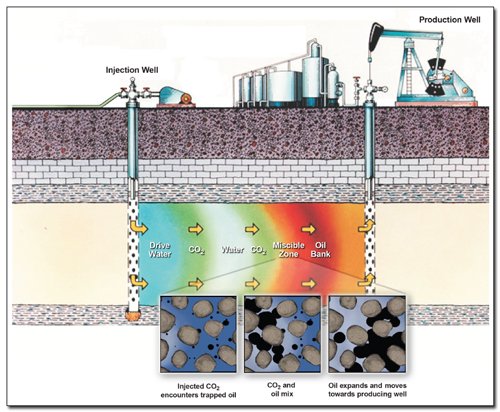
One common EOR technique in chemical flooding. In this technique, chemicals are injected into the reservoir to reduce the oil’s viscosity – the measure of a fluid’s resistance to flow – or improve its ability to flow. Thermal methods, such as steam injection, involve heating the reservoir to lower the oil’s viscosity and increase its mobility. Another technique is gas injection. In this technique, gases like carbon dioxide or nitrogen are injected into the reservoir to push the oil towards production wells.
Before applying these techniques, some changes are made in them according to the specific characteristics of each reservoir. These characteristics include factors like the type of rock, depth, and temperature. By using EOR, oil companies can significantly increase the amount of oil they recover from a reservoir to extend their productive life and maximize their economic returns. However, EOR methods can be complex and expensive to use, as they require careful planning and expertise. As technology advances, new and more efficient EOR techniques continue to be developed, helping to meet the growing demand for energy while minimizing environmental impact.
Explaining the Process: How EOR Works in Oil Extraction
Thermal methods in oil extraction involve the injection of heat into underground reservoirs to reduce the viscosity of the oil and increase its flowability. One of the most used techniques is steam injection. In this technique, high-pressure steam is injected into the reservoir. This process heats up the oil, which makes it less thick and easier to move through the rock pores towards production wells. Steam injection is particularly effective in heavy oil reservoirs, where the oil is very viscous and difficult to extract using conventional methods. Another thermal method is in-situ combustion. In this method, air or oxygen is injected into the reservoir to ignite the oil, generating heat and gas, which helps push the oil toward production wells. However, in-situ combustion can be challenging to control and may result in high levels of CO2 emissions. These thermal methods require careful monitoring and control to reduce the risks of the operation and guarantee the safety and efficiency of the operation. Overall, thermal methods play a crucial role in enhanced oil recovery by improving the mobility of oil within reservoirs and increasing overall production rates.
Modern Approaches to Enhanced Oil Recovery
EOR itself is aimed at optimizing oil extraction from under the ground using the methods described above. However, innovation has always been an integral part of technology, and EOR is no exception. One of these approaches is the use of nanotechnology. In this approach, nanoparticles are injected into the reservoir to change the properties of oil and its surrounding rock and enhance the oil recovery. Nanoparticles play the role of surfactants – materials to reduce the tension between oil and water. Thus, they make the oil flow through the well more easily.
Another modern approach is microbial EOR. In this approach, specially engineered microorganisms are injected into the reservoirs to process oil and produce by-products that help in oil recovery. These microorganisms change the composition of the oil and make it less viscous and thus easier to extract.
In addition to these methods, advanced reservoir modeling and simulation techniques are used in EOR. These techniques are used to optimize the design and operation of EOR projects, for better prediction of reservoir behavior and performance. Another modern approach is the use of data analytics and artificial intelligence (AI) in analyzing large amounts of data collected from the reservoir. The result of these analyses is used to identify optimal EOR strategies and improve decision-making processes. By using these modern approaches, oil companies will be able to maximize oil recovery from reservoirs and minimize environmental impact and operational costs.
EOR in Practice: Real-world Applications and Success Stories
There is no need to highlight the significance of Enhanced Oil Recovery (EOR) in increasing the production of oil from different reservoirs. An example of this technology is the story of Canada. In Canada and similar regions, steam injection is a widely used approach. This method, in Canada, has enabled the extraction of billions of barrels of oil that would have otherwise been completely uneconomical to recover. This is just one example of all projects and companies that use EOR in practice. Maximizing efficiency and paving the way for more sustainable energy extraction has made EOR more appropriate in different parts of the world.
HESCo Group, as an active company in the upstream sector of the oil and gas industry, has provided companies with Enhanced Oil Recovery techniques. We develop and provide protective solutions for a range of problems that you may encounter, providing advice and onsite training to protect workforces and properties worldwide. If you have any questions regarding how the work is done in Hesco Group, do not hesitate to contact us!